

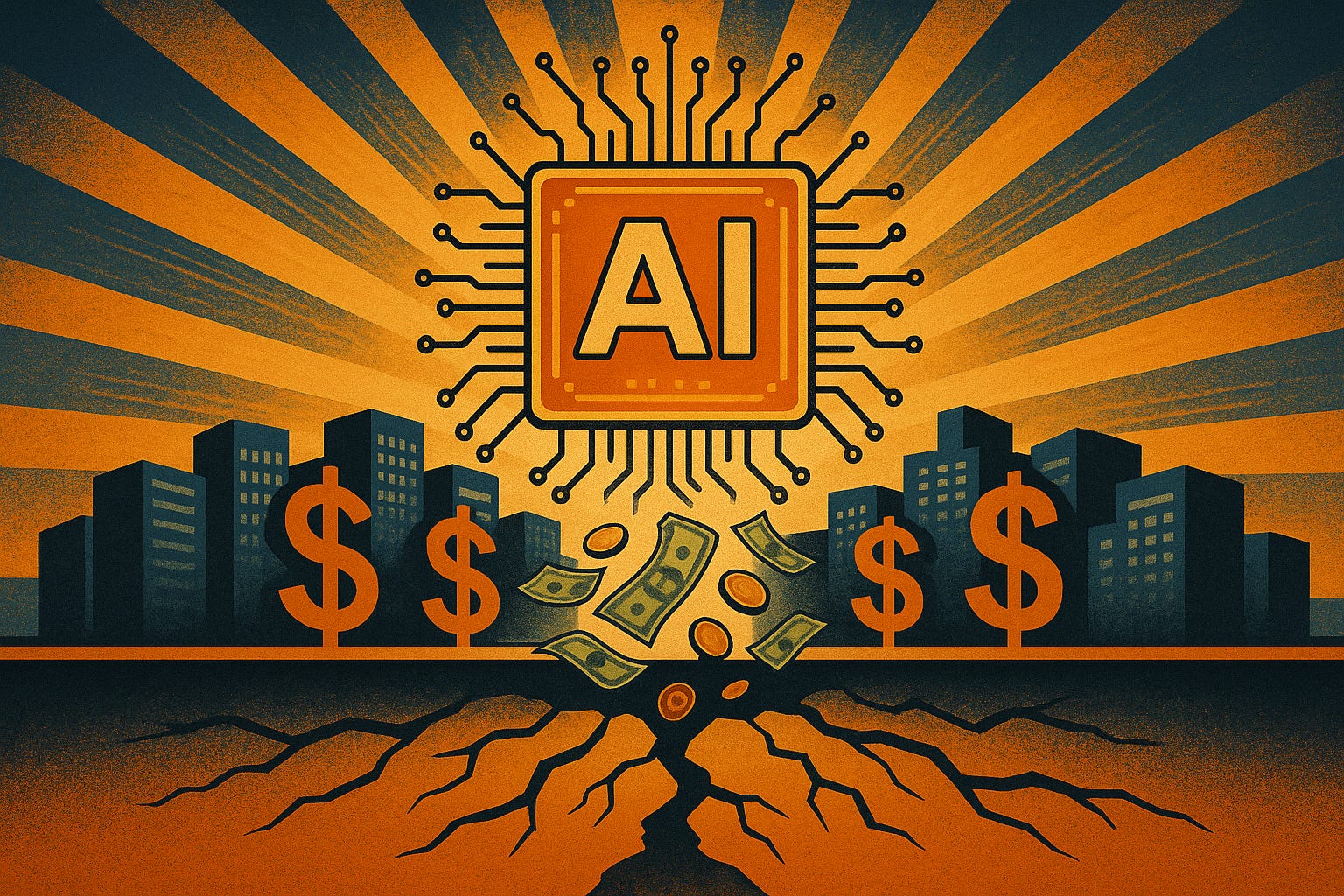
Good morning folks. I’m Felix Winckler from rule30, and this is Moneyball our monthly dispatch looking under the hood of AI’s rise. This edition asks a bold question: are we witnessing enduring foundation-building or the crest of a speculative wave? Recent data from NVIDIA and a cascade of new AI-product launches give the appearance of unstoppable growth. But dig deeper, and some early signs of structural strain begin to emerge.
At the top of the list this month: why today’s AI boom may not be built solely on technical brilliance, but on borrowed money, unmet expectations, and shaky fundamentals.
The Numbers Sound Amazing — But Are They Fundamentally Solid?
NVIDIA just announced $57.0 billion in revenue for Q3 fiscal 2026. That’s up 62% year-over-year and 22% quarter-over-quarter. Their Data Center business alone generated $51.2 billion, beating analyst expectations.
They followed up with an even more ambitious outlook: Q4 guidance of $65 billion, which is extraordinary in scale. This surge reflects “off-the-charts” demand for AI server chips and cloud GPUs particularly the latest Blackwell architecture.
Stocks responded: NVIDIA shares rose, and the boost rippled across AI-related equities globally, rekindling investor appetite for the whole sector.
But here’s where caution kicks in. Behind that boom lurk structural risks many markets are choosing to ignore:
Much of AI infrastructure buildup has been financed not by revenue but by debt. Some companies are borrowing heavily to fund GPU purchases and compute-heavy projects.
As AI spending grows faster than actual profits or stable cash flows, the sustainability of that debt becomes questionable especially if funding dries up.
If major buyers run into financing trouble (e.g., due to rising interest rates, tighter credit, or failed monetization), demand could collapse leaving excess hardware and unrealized orders.
On top of that, growth depends on assumptions:
continued expansion of data-center capacity,
re-opening or stable relationships in major markets (including China),
persistent competitive advantage for NVIDIA over rivals like AMD or Intel,
and enterprise users realizing real returns (not just hype) from AI investments.
In short: the hardware lead is real, but the long-term economic model backing it for many remains fragile.
New AI Tools, Fresh Hype — But Also Fresh Questions
Meanwhile, the wider AI ecosystem hasn’t been standing still. Recent weeks saw a flurry of major AI-product releases and upgrades, further fuelling both excitement and speculation:
Gemini 3 from Google is being hailed by some as the most ambitious jump yet for multimodal AI. Another strong signal of accelerating competition.
At the same time, Claude Opus 4.5 from Anthropic hit the streets, promising major improvements in coding, enterprise workflows, and long-form reasoning agents.
Finally OpenAI introduced GPT-5.2, its most advanced generation yet, boasting substantial improvements in professional knowledge work, long-context reasoning, multimodal perception, and coding performance. Benchmarks suggest it surpasses previous models on key tasks and delivers more dependable outputs, signaling a leap in real-world productivity use cases across business and research.
These pushes reflect a broader “AI upgrade race” from infrastructure to model enhancements to tools which, if matched by real adoption, could reshape how industries operate.
But great power doesn’t automatically translate to great profit. For many buyers cloud providers, enterprises, startups the costs (hardware, energy, talent) remain high. The question is: Will these newer tools deliver enough productivity or value to justify those costs?
Given the scale of capital already deployed (and planned), a downturn in demand or capital markets could leave many projects stranded with massive hardware overhang and little to show for it.
The Risk of an AI Bubble — What Could Trigger a Crash
Putting the pieces together reveals a fragile architecture. There’s real demand, real delivery, and real ambition but also big dependencies on capital flows, favourable macro conditions, and hype staying alive.
Because of these dependencies:
AI stocks now account for a very large share of overall gains in major indexes this year (>75% of S&P 500), which means the broader market is now highly concentrated and sensitive to AI volatility.
Early signs of stress are already visible: some large tech names have seen sharp stock drops after showing trouble generating AI-driven revenue.
If broader economic headwinds rising rates, credit tightening, macro-economic slowdown hit, capital-intensive AI projects are most vulnerable.
The scale of upcoming AI-infrastructure demand is massive: to justify it, buyers must deliver real value far into the future. That’s a high bar.
Which brings us back to the real question: Is this growth building a durable foundation, or are we inflating a bubble on borrowed money and unrealistic projections?
There is no doubt we are living through one of the most dramatic growth spurts in the history of computing. The revenue numbers are staggering, the engineering breakthroughs keep accelerating, and the ambition across the ecosystem (from models to chips to infrastructure) is unmatched.
And yes, history reminds us that high prices and insatiable demand don’t guarantee long-term success. To avoid becoming a bubble, this wave of AI investment needs real returns, sustainable business models, and the financial stamina to withstand market cycles. If the next few quarters bring failed monetisation, tightening financing, or softening demand, this boom could deflate far faster than it expanded.
But there are also strong reasons not to underestimate the staying power of this cycle:
• We’ve only scratched the surface of the robotics wave.
Most AI investment so far has gone into software. The next frontier physical automation through humanoids, warehouse robots, and industrial autonomy is barely out of the lab. As robots become commercially viable, compute demand may grow another order of magnitude.
• Enterprise AI adoption is still at day zero.
Despite the hype, only a tiny portion of Fortune 500 workflows are actually AI-powered today. Early pilots show meaningful productivity gains, but real operational integration takes years. The “slow burn” of enterprise adoption could support long-term infrastructure demand even if short-term enthusiasm cools.
• Entire categories of AI-native applications do not exist yet.
Every tech supercycle (PC, Internet, mobile) produced breakout companies 5–10 years after the underlying infrastructure matured. Many of the most valuable AI-native applications (agentic systems, autonomous tools, simulation-first industries) have not arrived yet.
• AI is becoming embedded in every layer of the economy.
From scientific research and logistics to drug discovery, finance, entertainment, and education, AI is no longer a niche category. It is becoming a general-purpose capability, and historically, general-purpose technologies (electricity, computing, the internet) tend to have multi-decade demand curves.
So yes: today’s AI market carries real risks. But it also carries the early signals of a durable platform shift.
If AI delivers on its promise (reducing costs, increasing productivity, enabling new business models, and unlocking robotics at scale) then this moment may be remembered not as a bubble, but as the early structural phase of the next great technological transformation.
For now, which path we’re on remains the most important question in tech; and the one we’ll keep tracking, month after month.
Other Bits Worth a Quick Look
Google’s NotebookLM steps up.
Google released a major update to NotebookLM, its AI-powered research and summarisation tool. The new version adds deeper source-reasoning, multimodal support, and collaborative capabilities, making it much closer to an AI “research partner” than a simple notes assistant.AI-augmented textbooks arrive.
Google also unveiled a new initiative to rethink textbooks using AI, introducing interactive, personalised learning materials that adapt to a student’s pace and curiosity. The concept, described in their post on reimagining textbooks with generative AI, signals the start of a major shift in educational publishing.ElevenLabs launches its AI Music Studio.
ElevenLabs expanded beyond voice synthesis with a new AI music generator, allowing creators to produce original tracks in seconds. Early demos show surprisingly high-quality compositions, placing ElevenLabs in direct competition with emerging AI music platforms.Video creation goes fully AI-native.
InVideo, available at invideo.io, launched new AI-powered tools that turn scripts into fully-produced videos complete with scenes, transitions, voice-overs, and pacing adjustments. It’s one of the clearest signs yet that end-to-end AI video production is about to become mainstream.Google’s “Banana Pro” Nano model.
In a slightly more niche but still notable release, Google published details on Nano Banana Pro — a tiny, on-device AI model designed for ultra-low-power environments, another step toward “AI everywhere.”
MIT’s “Iceberg Index” shows AI workforce exposure.
A new study from MIT and Oak Ridge National Laboratory — dubbed the Iceberg Index — estimates that current AI capabilities overlap with tasks totaling about 11.7% of U.S. workforce wage value ($1.2 trillion), particularly in cognitive and administrative work. The index isn’t a direct prediction of layoffs but highlights where AI could already perform significant job tasks if adopted widely, serving as a planning tool for policymakers and businesses.
Mistral 3 family launches with open-weight models.
French AI developer Mistral AI unveiled Mistral 3, a new suite of open-weight models including a large mixture-of-experts flagship and several smaller dense variants, all under an Apache 2.0 license, aimed at broad developer access and edge deployment. The release positions Mistral more competitively against major AI players and has already been integrated into services like Amazon and Microsoft clouds.Mistral AI adds OCR 3 for advanced document AI.
Mistral AI also launched Mistral OCR 3, an upgraded optical character recognition model that achieves a 74 % win rate over its predecessor on forms, scanned docs, complex tables, and handwriting — now powering Mistral’s Document AI Playground with cost-efficient API access for enterprise processing.
That’s it for this edition folks. Let me know your feedback, what’s missing, and what you’d like to see next time.
Until then, onward.
rule30 is an AI research lab building systematic strategies to trade venture assets at scale. We’ve dedicated three years to developing groundbreaking AI and machine-learning algorithms and systematic strategies to re-engineer the economics of startup investing.